Blog Archive

Sunday, January 29, 2012

The Ides of March (2011): Won't Get My Vote

The Ides of March is ostensibly about the cynicism and corruption of American political campaigns, political operatives and politicians. Ryan Gosling stars as Stephen Meyers, the dedicated and idealistic communications director for liberal Democratic presidential candidate Governor Mike Morris (George Clooney), in the days leading up to the fateful Ohio Primary, as Meyers discovers that his candidate is less than perfect, and that the business of politics can be dirty. Oh really. Who knew?
The ides of March is directed by Clooney from a screenplay he co-wrote. It tells us nothing, yet takes itself very seriously. In this, it reminds me a lot of Margin Call (2011), which revealed – very soberly – that Wall Street traders in credit default swaps etc were self-centered, amoral, profit seekers.
The basic story is engaging and entertaining, if you don’t think about it too much. The acting is excellent from a weak script. Clooney hits just the right notes as a likeable, photogenic, ideally progressive politician in the Jed Bartlet mold. Gosling is very watchable. His character is naively earnest, until the stars fall from his eyes, after which he is relentlessly, bitterly cynical. We get Phillip Seymour Hoffman doing his smug, smartypants thing as Morris’ campaign manager (and Gosling’s boss), Paul Giammotti, in his sleazy-manipulator incarnation,  as the manager of the opposing candidate’s campaign, and Evan Rachel Wood is pretty believable as the young intern eager to sleep with the powerful. Marisa Tomei and Jeffrey Wright do their best with shallow, cartoonish roles.

Ultimately, though we are left with a message movie with a trite message, and a political story that makes little sense.  There’s a little hint of romance, some backstabbing melodrama, and a revenge motif, none of which is explored with much interest.  The pace of the film is also out of kilter with the events of the story. It’s a hard fought primary coming down to the wire. Things are starting to go wrong. Yet nobody seems frantic, there are no late-nighters, and Meyer has plenty of time for dinner and drinks in the evening, a roll in  the hay or two, and personal errands during the day.
Aaron Sorkin’s The West Wing did this sort of thing with a great deal more realism, much sharper dialogue, and more interesting characterizations.

Available On Demand from Xfinity/Comcast and streaming from Amazon Instant Video; or on DVD from Netflix and elsewhere.


Saturday, January 21, 2012

The Iron Lady (2011): A Tin Movie

Meryl Streep’s performance as British Prime Minister Margaret Thatcher in The Iron Lady has received near universal praise.  The movie itself has gotten decidedly mediocre reviews from critics and consumers. I have to agree on both counts. If you’re a Streep fan, you’ll want to see this. If you are looking for insight or information about Mrs. Thatcher’s career, politics, philosophy, personality or motivation you will be disappointed. If you seek an interesting take  on her impact on British society, economics or international standing you won’t find it here. If you’d be satisfied with a good, solid story about an interesting person, The Iron Lady isn’t that, either, although it has its moments.

Margaret Thatcher was Prime Minister of Great Britain from 1979 to 1990, the first woman to hold that post, and the longest serving PM of the 20th century. She was a hard line conservative, very pro-business and lead the movement to dismantle  the UK’s ‘socialist’ policies, privatize government-owned industries, cut welfare spending, etc. She also presided over Britain’s victory in the short, and highly popular, Falklands War with Argentina. Most Americans, myself included, know little about her – other than the fact that she was sort of England’s Ronald Reagan, more strident perhaps, and not so warm and fuzzy.
In Britain, however, Thatcher was and remains a highly controversial and divisive figure, and  it seems nearly everyone has a strong opinion about her and “Thatcherism.”  As a result, The Iron Lady film has done boffo business there, with Tories critical of it’s portrayal of their sainted heroine, and liberals unhappy about the movie’s relatively uncritical approach to her politics. For us Yanks, however, the picture provides little context – historical, philosophical, political – for Thatcher’s reign or the period leading up to it.  It is so uninformative that it’s hard to get excited about the ‘drama’ of her political battles one way or the other.  
Meryl Streep’s role as Mrs. Thatcher takes two forms: the old lady and the iron lady. The story unfolds as a reminiscence of sorts by an elderly Thatcher many years after her fall from power. As the old lady, Streep gives a nuanced, touching portrayal of a once powerful woman, now widowed, drifting with her memories, not altogether  in the here and now, communing with the ghost of her beloved husband, Denis (JimBroadbent), and straining to maintain her dignity despite a faltering body and mind.  This incarnation of Thatcher is undoubtedly fictional, and, freed from the limits of biographical accuracy, Streep, director Phyllida Lloyd and writer Abi Morgan, do a lovely job imagining what it might be like to go from great power and responsibility to almost total powerlessness and dependency. The makeup department also deserves applause for, incredibly and believably, making Streep (62) look about eighty.
In real life, Mrs. Thatcher is reportedly well along the slippery slope of Alzheimers, and Tory critics of The Iron Lady have expressed outrage that the filmmakers would “stoop so low” as to depict her in this condition. The U.S. equivalent would be a film about Reagan showing him in his final, semi-sentient years; one can imagine the Republican uproar. However, I have to say that the depiction of the elder Thatcher does not seem at all mocking or predatory to me. On the contrary, it is quite sympathetic.
The retrospective meandering of old Mrs. Thatcher primarily covers two time periods:  The first is her early adulthood as young Margaret Roberts (Alexandra Roach), a politically engaged grocer’s daughter, who meets her future husband and then decides to run for public office to DO something to CHANGE things. Roach is fine in the role, as is Harry Lloyd as young Denis Thatcher. (Lloyd plays Viserys Targaryen in the hit series Game of thrones, but you would not recognize him as the same person here).
The second subject of reminiscence covers the period of the mature Thatcher’s ascendancy, from her decision to seek the Conservative Party’s leadership  in 1975 through her tumultuous years as PM beginning in 1979 and concluding with her ouster by fellow conservatives in 1990. Frankly, this portion of the movie bites off more than it can chew. The filmmakers try to show some of the highlights of Thatcher’s administration, but, as I noted at the outset, they give us no context for the dilemmas faced and decisions taken. This is a short film at 105 minutes, and only about half the running time is used to glimpse the iron lady in her prime, not enough by any measure.  The result is a hodgepodge of “events”, stagy little set pieces without a through-story and without any real drama. Oh, we see angry crowds, political demonstrations, and the like, but so what?  What’s going on?  We don’t know. Streep looks pretty good as the iron lady in her prime. But it is more an impersonation than a portrayal. If you’ve seen the trailer for this flick, you’ve seen most of this stuff already.
The failure is not Streep’s; it’s in the conception. This is film written by a woman, directed by a woman, about the most powerful British woman since Elizabeth I. I suspect that the point of the film is to show the fortitude and travails faced by this remarkable woman as she broke through gender walls into the male power bastion. In this it is modestly successful, mildly amusing, and not the least bit surprising. It is all well and good to want to want to make a point, and this particular point is certainly worth making, but in order for the moral of the story to resonate, the audience needs to be drawn into and caught up in that story, to care about the heroine. We do care about old, fading Lady Thatcher and are touched by her situation; but as to the tough as nails battle-ax prime minister, not so much.  In the immortal words of Governor Rick Perry, “Oops!”

In wide release.

Monday, January 9, 2012

The Descendants (2011): Clooney's Best?

The Descendants is not an avant-garde film; it is not an action–adventure movie or a thriller.  It does not break new cinematic ground, and does not seek to awe us with special effects wizardry or appeal to our prurient interest.  It is a straightforward story, well told, beautifully shot and extremely well acted, about an American family dealing with some very basic life issues: love, loss, connection, regret, kinship, grief, parenting, trust, and heritage. That’s a lot to pack into a story, and yet it’s a simple story really.

Matt King (George Clooney)’s wife Elizabeth is in a coma. Matt loves his wife, but there are unresolved issues, and regrets. In confronting her impending death, he and his two daughters, Scottie (10) (Amara Miller ) and Alexandra (17) (Shailene Woodley) need to support one another, but, as Matt has always been the “back-up parent”, they first must learn how to connect with and trust one another. This is a challenge, but not the only one. Matt and his extended family are descended from Hawaiian royalty and are the heirs, in trust, to thousands of acres of pristine land. As trustee, Matt is facing an imminent deadline for deciding how to dispose of this heritage land: sell it or preserve it somehow. All of this sounds boring in the summary, but in the hands of screenwriter and director Alexander Payne, The Descendants is anything but.

Payne’s films are character studies in the context of family relationships. We get to know the people in his stories gradually, through incidents - often humorous, sometimes not - and conversations. In films like About Schmidt (2002), Sideways (2004) and now, The Descendants, Payne shows us, and his protagonists, their deepest yearnings, needs and values, by peeling away the artifice and superficiality, bit by bit, like layers of an onion, and forcing these characters to confront their deeper selves. Payne believes in the goodness of people, and ultimately his characters learn, grow, and make wise choices, even if the process of getting there is painful.

Payne is also an actor’s director. He brings out the best in his players. About Schmidt may have been Jack Nicholson’s best performance of the last fifteen years, certainly his most sensitive; Sideways made Paul Giamotti a star, and was the defining career performance for both Thomas Haden Church and Virginia Madsen.  George Clooney has never given a more subtle, vulnerable and moving performance than his Matt King in this picture; it's arguably his best role in a career of great ones. Newcomers Miller and, particularly, Woodley as King’s daughters give similarly nuanced and touching performances. Also noteworthy here are character actor Robert Forster as Elizabeth’s grieving yet cantankerous father, Beau Bridges as a cousin pressing hard for the land sale, and JudyGreer, as a wife grieving over her husband’s infidelity and trying to forgive his paramour. Nick Krause as Alexandra’s young stoner boy friend also gives a memorable performance, at first humorously goofy, but with deeper layers as the story progresses.

The Descendants is also beautifully photographed. Hawaii is, of course, a pretty photogenic place, but cinematographer Phedon Papamichael eschews the usual visual tropes and presents the islands in a new light, not as a vacation paradise, but as a homeland, a real place.  The photography, and the mood of the film generally, is augmented by a lovely, evocative soundtrack of acoustic, exclusively Hawaiian music. You will want to download this!

For some reason, the picture has been rated “R” (“language” and “some sexual references”), but really, this is a family film – provided your family isn’t looking for explosions and CGI, and you are not concerned about the occasional f-bomb. (Clooney’s character repeatedly admonishes his youngsters to stop it.) I’d call it PG-14 or 15.

I was touched by this movie and its characters - even got a little moisty. It’s been mentioned, deservedly, as a candidate for best picture of the year, as well as multiple acting awards. I liked it and recommend it.   


In wide release.

Wednesday, January 4, 2012

My Best Films List 2011. And Yours?

Here's my twist on the typical year end film wrapup.  I saw a bunch of first run films in 2011, and a bunch more older films. Many of these were reviewed on this blog. Some were not.

Best/Favorite 2011 films I reviewed:

A Separation (Asghar Farhadi)


Moneyball (Bennett Miller)

The Girl With the Dragon Tattoo (David Fincher)

Hugo (Martin Scorsese)

Best/Favorite pre-2011 films I reviewed:

The Life and Death of Colonel Blimp (1943 - Michael Powell, Emeric Pressburger)

The Third Man (1949 - Carol Reed)

A Time For Drunken Horses (2000 - Bahman Ghobadi)

Best/Favorite films I watched in 2011, but did not blog about: 

Breathless (1959 - Jean-Luc Godard)  This classic is still fresh as a breeze.

The Best Years of Our Lives (1946 - William Wyler)   Affecting drama about returning servicemen.

What About You? What were the best flicks you watched last year?  Comment below.

The Artist (2011): This Silent Is Golden

The Artist is a charming little film, featuring beautiful, evocative and quite funny performances by costars Jean Dujardin and Bérénice Bejo. It also benefits from its novelty: it is made to resemble a silent movie from the late 1920’s and is, in fact (mostly) silent. The story is a bit trite, in the “A Star is Born” mode (male mentor’s career declines as female mentee’s star is rising). But, the picture is so well made and the actors shine so brightly, that little things like a slim plot don’t really matter. Somehow, the absence of spoken dialogue does not matter either. There are occasional slides with brief dialogue quotes, just like in the old silents; but the acting is more naturalistic and the cinematography far more sophisticated than those antique films.
Dujardin is not well known in the U.S., but is reputedly a pretty big deal in France. I can see why. He’s handsome, for one thing, and he has the most winning smile, which he trots out pretty much at will, to signify a wide range of emotions: shyness, surprise, pleasure, irony, wonder, self-satisfaction, lust, etc.  And expressive eyes.  And he can dance. He is the whole package. As silent movie star George Valentin, threatened by the advent of the talkies, Dujardin is, by turns, charismatic, mulishly stubborn and endearingly pathetic.


Bejo, an Argentine-French beauty, who happens to be married to the film’s writer/director Michel Hazanavicius, plays a young ingénue, self-styled as  "Peppy Miller", who is initially helped by Valentin, then quickly eclipses him in fame and fortune, all the while carrying a torch for him. She, too, has a brilliant, engaging light-up-the room and melt-your-heart smile. She also possesses wide set expressive eyes - very useful in a silent film – high cheekbones, sensual lips. Did I mention she was beautiful? On the basis of this picture alone, Berenice has landed a coveted place on the ‘girlfriend list’.


Both Bejo and Dujardin are potential Oscar nominees for best actress and best actor, and that may be reason enough to run out and see The Artist. The supporting cast, including John Goodman , James Cromwell and Penelope Ann Miller, are fine as well.  However, my vote for best performer in this movie would go to Uggie, a Jack Russell Terrier, who plays Valentin’s fabulous pooch as a clown, a buddy, and a hero.


If you feel you need a trial run to see if this silent movie is your thing, here’s a little clip.


The Artist may be the most charming nostalgia film since Midnight in Paris. Check it out.


In theaters.


Friday, December 30, 2011

The Girl With The Dragon Tattoo (2011): Hollywood Makes It Better

I don’t know exactly why I keep coming back for more. I devoured Steig Larssen’s book The Girl With The Dragon Tattoo and its two sequels. I watched all three Swedish film adaptations of same.  In fact,  I saw Män Som Hatar Kvinnor (2009) three times.  (“Men Who Hate Women” was the original title for The Girl With the Dragon Tattoo.)  So now we get the American remake, and I was compelled to rush out to see this, as well! I don’t hate women; I love women. I’ve even been described as uxorious. What’s going on here? And could I possibly enjoy seeing a remake of a mystery/thriller with which I am so familiar?

The Swedish films were pretty good, especially the first one, and they made a star of Noomi Rapace for her thoroughly convincing portrayal of the intriguing Lisbeth Salander. Ever since it was announced that an American movie was in the offing,  there’s been much handwringing by fans of Larssen’s Millenium Trilogy –books and movies - over how Hollywood would screw up The Girl With The Dragon Tattoo. You can stop your bemoaning. The new movie, directed by David Fincher and starring Daniel Craig and relative newcomer Rooney Mara, is excellent, even better than the homegrown Swedish edition.
The basic story is about the unraveling of a forty year old mystery involving the disappearance and presumed murder of a 16 year old girl on a private island owned and inhabited by the Vangers, one of Sweden’s most wealthy and powerful (and dysfunctional) families. A disgraced, left leaning journalist, Mikael Blomkvist (Daniel Craig) is hired by the aged patriarch, Henrik Vanger (Christopher Plummer),  to investigate and solve the musty mystery before he dies. Blomkvist is aided by a most unlikely co-investigator, a pierced, punk, aspergers-ish, autodidact, hacker named Lisbeth Salander (Rooney Mara). Along the way they uncover a series of horrific murders and ugly family secrets.
This was an A-list project from the start. Director Fincher (Fight Club [1999], The Social Network [2010]) is at the top of his form. The screenplay was adapted by Steven Zaillian, one of the best in the business (Awakenings [1990], Schindler’s List[1993], Gangs of New York [2002], Moneyball [2011], among others). The cinematographer, Jeff Cronenweth, worked with Fincher on Fight Club and Social Network. Their collaboration has resulted in a  thoroughly compelling, beautifully rendered film.  The  narrative has been honed so that it is easier to follow than in the Swedish product, without any sacrifice of the tension or the mystery. Some of the clunky techno aspects of the novel have been updated and tidied up so they make sense and feel contemporary in 2011. And, the plot has been tightened up in ways that make cinematic sense, although Larssen purists may complain just because there are differences.
One example of this has to do with how a mysterious (and crucial) list of initials and numbers in the missing girl’s diary gets deciphered. In the book and the Swedish film, this process involves some tedious procedural work by Blomqvist and Salandar – poring over old newspapers, driving around the country to dig out old police files and interview people, along with a drawn out inductive and deductive reasoning process. In the current picture, the revelations are uncovered by Salander alone, and a lot of her investigation is off camera – we see just enough to figure out how she done it. This works to everyone’s advantage (the movie is 158 minutes as it is).

The Lisbeth Salander character is just a great invention, and her quirky looks and behavior made the book and make the movies so interesting. Noomi Rapace was absolutely terrific in this role in the Swedish films -  a dark, guarded,  troubled spirit, yet brilliant, clever and resourceful. She was physically slight, yet like a coiled spring, and a surprisingly dangerous person to mess with. As portrayed by Rooney Mara, she has many of the same characteristics (tattoo included), yet seems to become a bit more human along the way. (Or maybe I’m just bringing more to the table this time around.) In any event, Mara is a believable Lisbeth.  
Daniel Craig is fine as Mikael, stronger, more sure-footed (and better looking) than was Michael Nyqvist in the Swedish films. Gone is the impervious tough guy character he evokes as James Bond. Here he is intrepid, but also thoughtful and vulnerable. Mikael’s relationship with his co-editor Erika Berger (Robin Wright), omitted from the earlier version, is elegantly referenced here, and I suspect this will pay dividends in the sequels, in which Mikael’s journalism career resumes. Stellan Skarsgard as Martin Vanger is also very effective. The rest of the ensemble, portraying the other Vangers, and a very evil lawyer,  is fine as well – there is not a weak performance among them.
I also have to draw attention to the fabulously moody and subversive (but not hummable) soundtrack by Trent Reznor (of 9 Inch Nails fame) and Atticus Ross. This is one of those films where the music/soundscape is integral to the creation of mood and emotion. Excellent
My only gripe about The Girl With The Dragon Tattoo is the opening credits, which are backed by a creepy and disturbingly graphic animation that, in retrospect, relates to the darker themes of the story, but stylistically has nothing to do with the film that follows.
Well worth a trip to your local screening room. Yes, even if you’ve read the book and/or saw the subtitled version.
Warning: There are a few disturbing bits in this film. They are necessary, relatively brief and well handled. I won’t describe further, but if this concerns you, ask someone who’s seen it.

In current release.

Wednesday, December 28, 2011

Mission Impossible - Ghost Protocol (2011): Cruise In Overdrive

How do these aging actors do it?  Tough guy action films, I mean. Sly Stallone (65), Liam Neeson (59), Bruce Willis (56), Nic Cage (pushing 50), among others,  are all still playing the stalwart macho hero. And now, here comes Tom Cruise in his fourth go round as Ethan Hunt, leader of a crack IMF (Impossible Missions Force) team, at age 49. Now I’m not suggesting that Cruise is old, certainly not from my vantage point (age 62). I am wondering at what point does casting of a middle aged or older fellow in such roles strain credulity too much? [See my comments on Neeson’s Unknown (2011).] The good news is that Mission Impossible - Ghost Protocol (a.k.a. M.I.4) is a terrific movie, and Cruise’s tough guy persona carries the film.
Gone is the boyish grin and youthful charm. Cruise’s Ethan Hunt is taut, rugged, clearly in charge, and all business. His body is buff and his face is chiseled. He does look older, mostly in a good way; but I couldn’t help noticing as he was doing his classic Cruise run (chasing a bad guy) that he was pressing a bit, and I couldn’t help imagining how brutal his exercise regime must be these days. (One odd effect of the new Cruise look is that his nose seems bigger, more prominent, in a weird sort of way, especially in extreme close ups, of which there are several in M.I.3. Anyone else notice this?)
Cruise (who also has produced all of these films) has aided his M.I. career by hiring terrific directors: Brian de Palma, John Woo, J.J. Abrams, and now Brad Bird. Bird was a bit of a gamble in that his entire career has been directing/supervising animated material, most recently at Pixar, where he helmed The Incredibles (2004) and Ratatouille (2007). Perhaps, Cruise noticed how beautifully the action moved and flowed in those projects, and how well the stories were constructed. At any rate, the gamble paid off, because the complicated story in M.I.4, involving stolen Russian launch codes and a terrorist plot to launch a nuclear missile  strike at the US, is well told, and moves along deftly with thrilling action sequences and just the right touch of humor.
Cruise and Bird are helped by an outstanding supporting cast. The other members of Ethan’s M.I. team, Simon Pegg, Paula Patton and JeremyRenner have distinct personas and skills. Pegg has had a great 2011, appearing in the comedy Paul, voicing the character of Det. Thomson (or is it Thompson?) in Tintin, and now Benjy, the somewhat timorous techie guy on the team. Patton plays the girl on the team, and what a girl: she’s beautiful, sexy, forthright and tough as nails when called for – as in the all too brief girl-fight scene with the ruthless assassin Sabine Moreau (French actress LéaSeydoux). Renner’s character is inadvertently drawn into the team. He is analytical, intense, loyal, funny and human. His performance is a revelation because he plays an ordinary guy, in contrast to the nut jobs I’d seen him play in The Hurt Locker (2008) and The Town  (2010). The ensemble also includes Michael Nyqvist as the bad guy, Hendricks, and the uncredited Tom Wilkinson (as the IMF Secretary) and Michelle Monaghan, in cameo reprise of her role as Ethan’s girlfriend/wife Julia.
I won’t bore you with a plot outline. If you like action pictures, you’ll want to see this one. It’s a big screen kind of movie, so don’t wait for the DVD.

In theaters.

My Week With Marilyn (2011): Viva Monroe, Viva Williams

Let me start out with the most salient observation: Michelle Williams just nails her role as Marilyn Monroe. I don’t mean that she looks just like her – she doesn’t, although the makeup department does a hell of a job engineering a pretty good facsimile. But watching Williams here, you forget you’re not watching the real Marilyn.  Her Monroe is sexy, of course, and also seductive, flirtatious, magnetic, glamorous and manipulative. At the same time, she is needy, insecure, petulant, childish.

Marilyn Monroe is the most iconic of movie stars. From about 1953 until her death, she was MM, the “blonde bombshell”, a unique combination of sex and innocence, of bimbo and girl next door. She was everyman’s fantasy girl. She was Hugh Hefner’s first ever centerfold. She parlayed this image into fame and fortune, but not happiness. Her shocking death by apparent suicide in 1962  enhanced her mythic status, while at the same time, sparked an industry of revelation about her life and her liaisons, and a lot of soul searching about her complicated personality, the meaning of her death, America’s contradictory  attitudes and expectations about women, and so forth.  Williams’ accomplishment in My Week With Marilyn is how she transforms the icon into a virtual flesh and blood human creature, an amalgam of the mythic star and the frightened Norma Jean. This feat alone is a strong recommendation to see this picture.

There is a small sub-genre of the “coming of age” picture that examines a young person’s first scary or daunting, yet life-changing experience in the entertainment industry - typically involving a confrontation with a powerful,  larger-than-life figure: an actor (e.g. the fictional Alan Swann, played by the legendary Peter O’Toole in My Favorite Year (1982)), or a director (e.g. Orson Welles, magnificently portrayed by Christian McKay  in Me and Orson Welles (2008)), or a rock star, painter, etc.  The events unfold through the eyes and feelings of the young protagonist; invariably there’s a subsidiary romantic angle also, but the main event is the angsty relationship between the kid and the celebrity.

My Week With Marilyn, based on a true story by Colin Clark,  falls into this category, although there are a couple of twists to the formula: First, Colin (Eddie Redmayne), our young protagonist, pairs up with not one, but two iconic superstars:  the brilliant, lionized actor/director Sir Lawrence Olivier (Kenneth Branagh) and  Marilyn Monroe. Second, the love story, i.e. Colin’s growing infatuation with the superstar Monroe, is not only a love story, of sorts, but it is also the central event that provides a life lesson to the young man and is, of course,  the primary focus of the movie.

It is 1957.  Colin, through comical perseverance and family connections, has managed to finagle himself a job as 3rd Assistant Director (i.e. go-fer) on the set of Olivier’s next movie, The Prince and theShowgirl. Olivier has cast the international sex symbol Marilyn Monroe as  “the showgirl” to put a bit of sizzle back in his life - as if being married to Vivien Leigh (Julia Ormand ) wasn’t exciting enough. Monroe was a superstar by this time, with a resume including Gentlemen Prefer Blondes (1953), How to Marry A Millionaire (1953), The Seven Year Itch (1955), and most recently, Bus Stop (1956). She attracts a crowd wherever she goes, and both loves and hates the attention.

Monroe comes to rehearsal with a retinue that includes her new (third) husband, the playwright Arthur Miller, her acting coach, her manager, a bodyguard, etc. She is more than a little nervous to be directed by and costarring with the great Olivier. But their styles couldn’t be more different.  Monroe, having recently studied  the Method with Lee Strasberg, believes acting requires inquiry into her character’s motivation (although the film they are shooting is a farce).  Monroe’s fragile psyche needs to be treated with acceptance, understanding,  praise, and love. Olivier is not that sort. He merely expects an actor to be on time, to know her lines, to take direction - in short, to be a professional.

While Branagh’s Olivier froths with frustration, Williams’ Monroe is paralyzed with anxiety. She frets, she can’t get out of bed.  She needs a friend; she needs comforting. And therein lies Colin’s little story.

My Week With Marilyn is a sweet, funny little movie, and very well acted up and down the cast.  Branagh gives us a volatile, and surprisingly sympathetic Sir Larry, one of his most convincing recent performances. Also featured, in smaller roles, are Michael Kitchen (of Foyle’s War fame); JudyDench (always wonderful); the familiar, yet under-rated Phillip Jackson, as Monroe’s dour bodyguard; Ormond, as the slightly faded, but still intriguing Vivien Leigh; and Emma Watson, as Lucy, a wardrobe girl of interest to Colin, until that platinum blonde walks by. The jury is still out as to whether Watson [Hermione in the Harry Potter series] can actually act; she does a just passable job here.

I kind of liked Eddie Redmayne as Colin. I mean I can’t really fault his performance. But Colin’s story and Redmayne’s performance  were so overwhelmed by the supernova character that was Marilyn Monroe and the  standout acting of Michelle Williams, that I hardly noticed him.

This movie is quite entertaining, and Williams’ performance may well win her an Oscar and/or Golden Globe in the coming months, so you may want to catch it on the big screen; but it also will do just fine on your home  screen, when the DVD is released, if you care to wait.

In theaters.
Incidentally, The Prince and The Showgirl(1957), with the real Marilyn and Olivier is available on DVD from Netflix and elsewhere.

Friday, December 16, 2011

The General (1998) and The Guard (2011): Hail Brendan Gleeson

These two films starring the wonderful Irish actor, BrendanGleeson, are  both crime films about a couple of antiauthoritarian mavericks, one a crime lord and one a cop. In 1998’s The General, Gleeson plays Martin Cahill, in a biopic about the notorious Dublin gang leader, who, rising from very humble beginnings,  became something of a Robin Hood folk hero in the 80’s and early 90’s for his ability to outwit, and even mock, the police while stealing from the wealthy (no evidence he gave to the poor, however). In the recent movie, The Guard, Gleeson plays Sergeant Gerry Boyle, a member of the Garda (i.e. a cop) in a small coastal town, who gets caught up, against his will,  in an investigation of international drug smuggling,  paired with an African-American FBI agent (Don Cheadle), with characteristic "buddy cop movie" results.

Gleeson has appeared in many, many films, mostly in supporting roles, over the years. Examples include Into the West (1992), Gangs of New York (2002), Cold Mountain (2003), Troy (2004), and most recently, several of the Harry Potter films, in which he played a memorable ‘Mad Eye‘ Moody. In 2008 he shared the lead in Martin McDonagh's In Bruges with Colin Farrell, but despite a fine performance, received less attention than his costar. In The General and The Guard, Gleeson is definitely the center of attention and in each his performance is riveting.

I confess that I love the mug on this guy, which juxtaposes an  impish boyishness and a mature manliness. That, and Gleeson’s ability to express his character's thoughts and emotions subtly and unmistakably – through a wink or squint of his eye, a twitch of his mouth, a move of his eyebrow or whatever works. Gleeson can show us an infectious smile and in the next moment a stalwart, grim resolve. In so doing, we feel we know this guy, his character, in a way that dialogue or action alone could never convey. His amazing physiognomy sits atop a rather large, lumpish, definitely non-svelte body, all of which somehow adds to the attraction.

The General starts off with Cahill’s assassination by an IRA gunman, in front of his home in 1994 at age 45. The rest of the movie traces his life and career leading up to that point, starting with his youthful exploits, stealing food for his family, flipping off the chasing constable who cannot catch him, and highlighting some of his most famous and notorious exploits. Cahill is depicted as a guy who cannot abide constraints or authority, a freedom loving man, who nonetheless becomes less and less free the more successful he becomes. In the able hands of veteran director John Boorman (Deliverance, Hope and Glory, Excalibur), the film gives us a multidimensional picture  of a complex guy:  ruthless and cunning crime boss, loving father, man of the people, husband, hunted man, tough guy and sensitive guy.
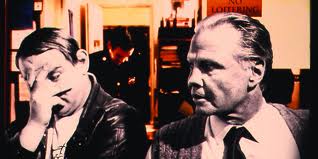
Along the way we catch glimpses of the people  in Cahill’s world: Inspector Ned Kenny, the frustrated cop who understands him, but can’t catch him (well played by Jon Voight), his best friend Noel (Adrian Dunbar), the various characters in his gang of thieves, his supportive wife, Frances (Maria Doyle Kennedy) and her sister - and Cahill’s alternate ‘wife’ - Tina (Angeline Ball). Cahill seemed to enjoy his celebrity, but he famously shielded his face with his hand whenever cameras may have been present. This happens frequently in the movie, setting up an interesting challenge for the actor, which Gleeson meets quite successfully.

The Guard is a fictional work, but its protagonist is a real, flesh and blood character. Sergeant Jerry Boyle likes to drink, consort with whores, subvert authority, and take care of crime  in his coastal town according to his own idiosyncratic sense of what’s important and what’s not. He is unmarried, and seemingly uninterested in deep relationships, with women or with men. He is close with his mother (beautifully played by Fionnula Flanagan), but she is dying. He accepts the human condition with humor and resignation. Live and let live is his philosophy. Until, that is, an international drug trafficking operation lands on his shore, a neighbor and a colleague get killed (“mordurred”), and FBI agent Wendell Everett (Don Cheadle) demands his help.

Taking orders is not really Jerry’s thing.  Being commandeered by a sophisticated, rule-bound, uptight, know-it-all American  cop really gets his goat. That this cop is black is like hot sauce on his burrito. What starts as a lovely character study evolves into, first, an odd-couple comedy and then into a bit of action thriller. Writer and first time director John Michael McDonagh (brother of playwright/screenwriter Martin McDonough) makes all of this come together in an entertaining package.  Gleeson makes this role his own, in perhaps the best performance of his career. His Jerry Boyle is annoying, funny, endearing, and, at his core, a man with a clear sense of self. Cheadle (Devil in a Blue Dress, Hotel Rwanda, Crash, etc) is always good; here, he plays a straight man to Gleeson, but he gives his character a palpaple integrity, and shows us his (and our) gradually developing recognition of Jerry Boyle’s hidden depths.

The General and The Guard are both excellent films, which I wholeheartedly recommend. (The recommendation comes with a proviso: if you are not Irish, you may have some difficulty catching all of the dialogue. If you have a DVD, you may want to engage the English subtitles. Without subtitles, I probably only clearly “got” about 50% of the dialogue in The General. I did a little better with The Guard, thanks to Cheadle’s presence, but conversations between the Irish were still tough. Even so, I enjoyed both movies.)

The General is available on Netflix streaming and DVD, Amazon instant video, and Hulu Plus. The Guard will be available on DVD and Blue-ray through Netflix on January 3, 2012


Monday, December 5, 2011

Hugo (2011): Scorsese's Steam Punk Family Movie

Martin Scorsese, esteemed director of markedly adult, often violent dramas (Mean Streets, Taxi Driver, Raging Bull, The King of Comedy, Goodfellas, The Departed, etc.) and the occasional documentary (The Last Waltz, No Direction Home: Bob Dylan, My Voyage to Italy, etc.), has, for the first time, made a children’s/family film, just in time for the holidays, and in 3-D no less! Hugo is a warm, engaging, imaginatively realized, perhaps even inspiring, work, clearly a labor of love by the director. It is a film best seen on the big screen if possible, preferably in 3-D – which is used beautifully here – and well worth your precious ducats for the experience.
Hugo offers a rich visual experience from the opening frames, as the camera swoops over 1930 Paris into busy Montparnasse railway station, through the crowds and cafés, down the platform, past the steaming trains and into the giant gears of a large station clock, behind which is the lair of our 12-year-old protagonist, the namesake of this movie. Hugo (AsaButterfield) is an orphan, living behind the walls of the train station, keeping the clocks wound, and tinkering with, trying to fix a mysterious automaton (kind of a robot) that his deceased father (briefly played in a sweet cameo by Jude law), a clockmaker/mechanic, rescued from obscurity in a museum. (Sounds complicated, but it's not.)
Hugo's environment is decidedly steam punk. Gears, great and small are revolving, puffs of steam abound, evocative of the factory in Chaplin’s Modern Times. Then, there are the interlocking gears of Paris itself, of the trains, and of the story.
Hugo’s is a lonely life. He peers down on the station denizens, watching their rituals, noticing little human vignettes playing out before his eyes, in pantomime, for he is too far away to listen in on conversations. Through this device, Scorsese pays tribute to the power of silent films. Especially touching, is a tentative love affair between a middle-aged gentleman (Richard Griffiths) and a café lady (Frances de la Tour). There is also a cute budding relationship between the station inspector (policeman) and a flower seller (Emily Mortimer).
Hugo is required to live by his wits, stealing food and the occasional spare parts for his "work". This puts him at odds with the station inspector (humorously yet menacingly played by Sasha Baron Cohen), who is out to nab him, adding an element of hide and seek to this movie’s recipe. The spare parts, gears, etc. that Hugo needs come from a magic store/toy store in the station, and this brings him into conflict with the store's owner, Papa George (Ben Kingsley, in a great, nuanced performance). On the plus side, Papa George has a 12-year-old ward, Isabel (Chloe Grace Moretz) who becomes Hugo's friend. Adventures and intrigue ensue. Along the way, Hugo learns and grows, and Scorsese gets to embellish his themes.
These include the power of dreams, the satisfaction of meaningful work/purpose, and, most especially the wondrous joy of film itself, and the importance of appreciating and preserving film history. Central to the story is the life and work of Georges Méliès, an early film pioneer, one of the first great producer/directors, sometimes known as the "father of special effects," because he specialized in fantasy and science fiction, virtually inventing those genres. Several of Méliès works are featured in Hugo, most prominently his most famous picture: A Trip to the Moon (Le voyage dans la Lune) (1902) in which a spaceship lands smack in the face of the man in the moon! Méliès made over 500 films between 1896 and 1914, when his output suddenly ceased. Why this happened is one of the mysteries central to the plot in Hugo. (It is not historically accurate but makes for a good story.)
Scorsese also features clips from other classic silents, including Charlie Chaplin, Buster Keaton, and Harold Lloyd. And, he gets to show us how state-of-the-art filmmaking, in the hands of a master, can advance the same basic thrills provided in those early films. For example, there is a wonderful moment in which we get to see a great train come off the rails and charge through the crowded station, out into the street. Scorsese loves film and film history. He has written about it. He is made two lengthy documentaries on the subject (one about American film, the other about his love for Italian cinema). Among other things, Hugo is a loving homage to the foundations of and power of cinema.
The cinematography, by Robert Richardson (who has previously worked with Scorsese on a number of films, including Casino, The Aviator, And Shutter Island), is rich, atmospheric, and well attuned to the nuances of the story. The depictions of 1930 Paris from high above are magical. As noted, the steam punk interiors of the station are moody and effective. There is a re-creation of Méliès’ studio and the staging of his films that is spot on brilliant. There are also nods to Orson Welles, Terry Gilliam, and countless others. The 3-D is used in furtherance of mood and story, further establishing that this technology is coming of age (before our eyes, so to speak).
The acting by all of the principals and most of the secondary players is excellent throughout.  In addition to those already discussed, Christopher Lee, as a kindly librarian, and Helen McCrory, as Mrs. Méliès, are fun to watch
Don't let the label of "family film" deter you: anyone who loves movies should enjoy Hugo, regardless of age. And, given its length (129 minutes) and pace, this movie may not be suitable for children under 11 or 12.

In wide release.