
The 1982 Blade Runner,
of course, is the much beloved
masterpiece from Ridley Scott [Alien (1979), Thelma and Louise (1991),
Gladiator
(2000)] set in what we now have to call an alternative universe (originally it
was an imagined future) in which anyone with any wealth lived “off-world”. Earth,
epitomized by a dark, wet, claustrophobic Los Angeles, brightened only by garish
oversized electronic ads everywhere, was a nasty, overcrowded and often brutal
place for those left behind. The picture starred Harrison Ford as the blade
runner Deckard, with a cast that included Rutger Hauer, Sean Young, Daryl
Hannah and Edward James Olmos. It was a groundbreaking movie - a dark, visually
stunning blend of neo-noir detective story and dystopian sci-fi suspense
thriller.
No spoilers, but let’s start with a bit of background:
In the Blade Runner
universe, there are “replicants” – androids (which is to say manufactured
creatures), in this case flesh and blood beings that are largely
indistinguishable from natural-born humans (aside from their means of creation)
only much stronger. They also have relatively short lives of just a few years. In
the original film, the replicants are made and used as slave labor for mining
and other dangerous work on some of the off-worlds and, because they are
considered sub-human and themselves dangerous (and dangerously rebellious), they
are forbidden on earth. Special detectives, known as blade runners, track down and “retire”, i.e. destroy, any rogue
replicants who manage to sneak back. Deckard, a Sam Spade type, is one of the
best of these cops. Early in the film, he is tasked with tracking down and
retiring four suspected androids. The job
is intriguing, and he attacks it with some relish. But then the unexpected
happens: He falls in love with a highly placed replicant from another world, and
his attitude about these people changes. He starts looking at his job as
murder.
The core story in Blade Runner 2049 is not so
different. Thirty years on, there are still replicants, but they’ve been
improved. Their longevity has been increased. They have implanted memories of
the childhood they never had. But for this they are much the same as other
people, except of course that they must live as a subservient class. And they
can’t reproduce. Also, because the new replicants have been engineered to obey,
they are no longer considered dangerous (or rebellious). In fact, replicants
are so reliable and obedient, they are often employed as blade runners
themselves – to track down and retire the few remaining older models.

And so, in Blade Runner 2049, we have “K”, so
named for the first letter of his serial number, played
by Ryan Gosling. He is
a blade runner walking in the big shoes of his predecessor, Deckard, and
filling them pretty well. And the same can be said for director Villeneuve, who
produces a film sequel not only worthy of its heritage, but possibly better
than the original.
Velleneuve is a more thoughtful director in some ways than Ridley
Scott – by which I mean his movies seem
more contemplative. It’s not so much
that his protagonists are more pensive or introspective. Rather, this director
has a way of melding story and action with provocative moral dilemmas, and
giving his hero (and us) the space to reflect on the complex implications of such
situations. The pacing of his films in key sequences - the soundtrack and
cinematography soar as the actor looks around or the camera zooms in and holds
a close-up as he experiences a sudden, perhaps profound realization or
unexpected grief (or joy) - all of these things accentuate and illuminate the
emotional reaction and spirit of key characters in a way that feels quite
profound and moving. This approach is what made Villeneuve’s last picture, Arrival,
not just a suspenseful movie about aliens, but also a meditation about the
wonder of communication, the true meaning of connection, and the direction of
time.
 And so it is with Blade Runner 2049. There’s plenty of
action and great visual style here, for sure. But there’s a lot more, too. This is evident from the first scenes as K soars out of the noirish city into an equally noirish countryside, across vast fields of solar energy accumulators, to eventually set down beside an aggregation of greenhouses and a rural farmhouse. He walks in, looks around and waits. He knows what he’s doing though he’s not happy about it. Eventually the farmer, Sapper Morton (WWE star, Dave Bautista), walks in. Having seen K’s craft landing, he suspects what’s to come, as do we. Yet the meeting of these two men crackles with suspense. Morton asks K, who is sitting in the shadows, if he’s come to take him in. K regretfully replies that if that were an option, he’d gladly take it. Morton asks K how it feels to hunt down his own kind.Eventually, there’s a
lunging, violent, desperate struggle. “You can only do this because you’ve never seen a miracle,” Morton
says at the end – an enigmatic expression that haunts K and the rest of the movie
as the story unfolds.
Outside Sapper’s home, there’s a tree. Even a long-dead one
like this is a rarity in 2049. K notices an unusual carving on this tree, and
his drone – which detaches niftily from his vehicle and flies about at K’s
command – discovers a box buried deep beneath it. The box contains bones, and
the bones contain a clue that could upend the premise of the powerful replicant
industry and the public perception of replicants generally. The details are
tantalizing but complicated – better revealed by the movie than by this
reviewer. But I can say a couple of things: the investigation of the bones and
their implications eventually leads back to Deckard; and K finds that his own
identity is implicated. His girlfriend, Joi (Ana de Armas) tells him “I always
knew you were special.”

Of Blade Runner 2049’s many
imaginative ideas and visually interesting accomplishments, none is more
interesting or pleasing then Joi. She is a computer generated digital companion
- not unlike the character Samantha (famously voiced by Scarlett Johansson),
Joaquin Phoenix’s helpmate and romantic interest in Spike Jonze’s Her
(2013). But Joi is more than a sexy voice – she is represented by a holographic
image, one that changes outfits in a twinkle to fit her mood or her intuition
of K’s desires. She cares for him, and K clearly harbors reciprocal feelings. Around
Joi, K can lighten up and, if only momentarily, feel human. Needless to say,
she is lovely. Joi rechristens K, calling him Joe.
In the Blade Runner universe, even more than in ours, mighty
corporations rule. In the original Blade Runner, the Tyrell Corporation
– the developer of replicant biotechnology - was the especially powerful. In Blade Runner 2049, none is more
powerful than the Wallace Corporation which, not coincidentally, has taken over
the replicant monopoly. It’s run by the mysterious Niander Wallace – Jared Leto
with creepy, opaque eyes – pulling strings and manipulating events with a calm,
sleazy manner that emphasizes rather than belies his evilness. His character is
under-written or under-played and so has less impact than probably intended. On
the other hand, his henchwoman, a cold and efficient replicant by the name of
Luv (the Dutch actress, Sylvia Hoeks) takes on the bad guy role as K’s nemesis
with considerable brio (notwithstanding her emotionless mask). She’s dogged,
intelligent and vicious,– and of course pretty, reminding this old-timer of
Hugh Hefner’s late sixties paramour/sidekick Barbi Benton albeit with her dark
hair pulled tightly back into a pony tail.
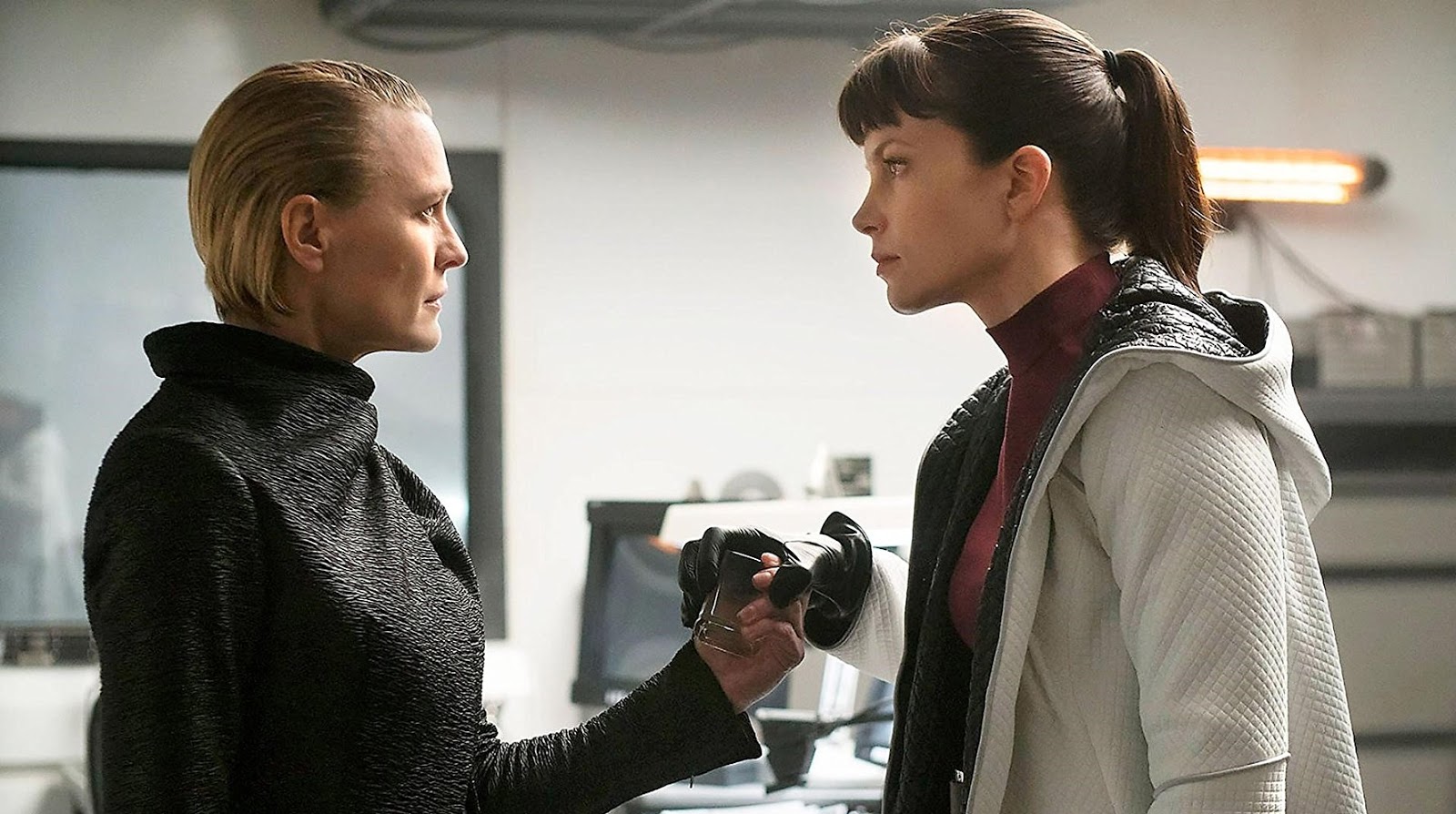
Robin Wright plays K’s boss, Lieutenant Joshi, whom he calls
“Madam”. Madam runs a tight ship and is very clear that her overarching
function and that of the blade runners generally is “to keep order”, with the
implication, at least to me, that she is referring to the fascistic form of the
word. While we sense that Madam may harbor a little soft spot for K, she is
very clear that that which separates them is more than rank or class. At one
point, K seems to hesitate when given the assignment of removing an
inconvenient person, and says "I never retired something that was born." He adds that his disquiet is because" to be born is to have a soul." Madam dismisses this concern, remarking that K has gotten along just fine without one.
Swiss actress Carla Juri is Dr. Ana Stelline, whose job it is to create childhood memories to implant in the replicants. K consults Dr Stelline in the hope of understanding his own memories – are they implanted or could they be real? As it turns out she is more important to the story than either of them realize.
Eventually for reasons I can’t reveal, everything comes back
to Deckard, who it turns out is living very comfortably but very alone off the grid in the abandoned city of Las Vegas – in a casino appropriately enough. Harrison Ford seems to be making a new career reincarnating some of the blockbuster roles that made him famous. A couple years ago, he reappeared as an aged Han Solo thirty-three years after Han’s last screen role inThe
Return of the Jedi (1983) and now he’s back as Deckard thirty-five
years after his first go around. (He is slated for another Indiana Jones picture, too, projected for a 2020 release.) Ford is
a better actor now than he was in the seventies and early eighties. The scenes
where his Deckard and Gosling’s K meet and get acquainted bring out the best in
both actors, and should be savored by fans of each, and in fact fans of good
acting generally. I’ve not heard any rumors to this effect, but it would not
surprise me if these guys received multiple award nominations for their work
here, Gosling for best actor and Ford for best supporting actor.

At their core, both Blade Runner films tackle moral concerns
that are becoming increasingly relevant as the rapid technological advances in
robotics, artificial intelligence, neuroscience, genetics, bioengineering and
cloning are converging; as talk of creating intelligent, emotionally sensitive robots
becomes ever more common; and the prospect of actually developing such robots –
or even flesh and blood androids like the replicants - becomes less fantastic
and increasingly feasible. Scientists are already discussing not only the
ethical boundaries of these creative efforts, but also issues relating to whether
intelligent robots can have a consciousness and if so, will be “beings” deserving of legal rights.
These questions, although framed in the context of
artificial intelligence and robotics, have a more existential and philosophical
angle to them. Similar questions have been raised in other stories, most
recently in the series Westworld, but perhaps never so
cogently as here. What is intelligence? What is identity? What is a person? If
someone feels, thinks, talks and acts like a human being, does it matter if she
is “of woman born”? Is a cloned human a human? Is a replicant human?
Blade Runner 2049 is a long movie running approximately two and three quarter hours - with very little of what might be called filler. Villeneuve needed all that time to tell the story and amplify its themes. The time is well spent. The film is visually stunning, intellectually stimulating, with plenty of long-fuse suspense, and at all the right moments viscerally exciting. I recommend it.
2 hours 44 minutes.
Grade: A-
In wide release.


