Blog Archive

Thursday, March 24, 2022

My year in movies (2021)

                                    - by Larry Lee

It’s time again to consider the best movies of the year.  In this case, that year is the plague year of 2021.  The Golden Globes have been awarded (The Power of the Dog for Best Drama, West Side Story for Best Comedy or Musical), the BAFTA nominations are out (Belfast, Don’t Look Up, Dune, Licorice Pizza, The Power of the Dog), and Oscar voters have now settled on their nominations.  Here are the nominees for Best Picture:  

  • Belfast
  • CODA
  • Don't Look Up
  • Drive My Car
  • Dune
  • King Richard
  • Licorice Pizza
  • Nightmare Alley
  • The Power of the Dog
  • West Side Story

We recently celebrated Chinese New Year but for movie fans, the year is not quite officially over, as a few movies from 2021 have yet to be released to the general public, including three foreign language films on the Academy’s short list, although none ultimately were nominated:  Great Freedom (Austria), Plaza Catedral (Panama), and Playground (Belgium).  Perhaps these three will still see the light of day.  One nominee for Best Costume Design, Cyrano, was finally released into theaters in mid-February.  Still, it is a time to reflect on the past year and consider the achievements of those who make the movies we all love so much.  As expected, significant differences of opinions abound.  For example, A.O. Scott, one of the principal film reviewers for the New York Times, considers Bad Luck Banging or Loony Porn, from Romania, one of the best movies of the year.  It is not.  But Mr. Scott probably sees many more movies than the average fan and it stands to reason he would have a different perspective on things.  For myself, I see more than 100 movies a year, and they range from action and superhero movies to esoteric film festival indies and foreign movies.  Even bad movies often have something of value in them (yes, even the Loony Porn one), and even a movie that does not rise to the top for the year can intrigue us, make us pause, make us think:  about ourselves, our assumptions, our relationships, our politics, and about the state of the world.  

And so it is this year as well.  A movie like the understated Azor (available on MUBI, or Amazon Prime rental) had me running to Wikipedia to refresh my understanding of the Dirty War in Argentina and got me wondering how I would have reacted to living in such a corrupt and randomly violent time.  Hive (available on Criterion, or Amazon Prime rental), shortlisted by the Academy for the International Feature Oscar, got me thinking once again about the conflict in Kosovo and what ordinary people will do just to survive.  (Incidentally, Hive would make a nice Balkan double feature with last year’s wonderful Quo Vadis, Aida? from Bosnia.)  And I’m Your Man (Hulu, or Amazon Prime rental), Germany’s submission for consideration for the International Feature Oscar, asks us to ponder what is truly important in a mate or even just a life companion, and what compromises we are willing to make to have the semblance of a happy, non-lonely life.  All three films are fascinating, may make you reflect on your own life, and are well worth seeing despite falling out of my top ten (and missing out on an Oscar nomination).

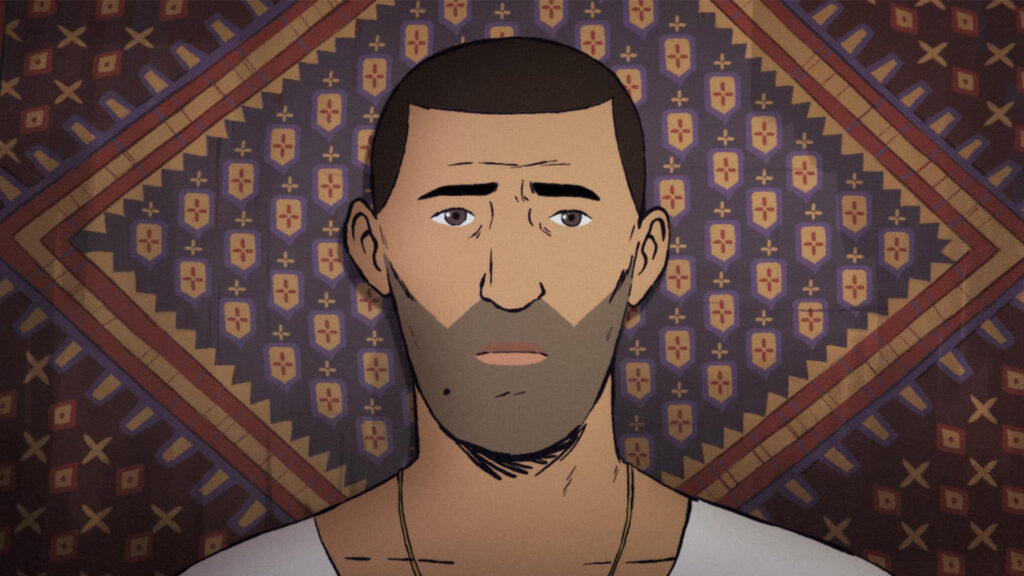
The year also had me once again admiring the art form that is cinema and underscored the unlimited and creative ways film can be a medium for telling a story.  In Flee (rentable on Amazon Prime), we learn the true — and heartbreaking — story of an Afghan refugee, told in his own voice, although his reality is rendered almost entirely in a kind of weirdly realistic animation.  The Green Knight (rentable on Amazon Prime) sent me back to Wikipedia to learn about the medieval tale of Sir Gawain and the Green Knight. The movie was a tour de force of creative storytelling, a tale of fantasy and imagination written at a time
when magic was assumed to exist in the world.  The medieval world in The Green Knight existed so long ago that it is almost completely foreign to us now, like a world that could have appeared in Dune.  And in the documentary Procession, (Netflix), four grown men, heretofore strangers, come together to recall their rape as children by Catholic priests, to revisit the physical locations of their trauma, and — amazingly — to make short films about their traumatic experience.  To watch these sexual abuse survivors actually make movies to help them process their psychic injuries was overwhelmingly powerful.  While there is certainly a place for conventional story arcs, like bad guys getting their comeuppance and happy endings all around, these three movies show that there are many stories to tell, and many ways to tell them.

Random Thoughts About The Oscar Nominations

The Oscar nominations provided few surprises, perhaps due to the enormous pre-nomination media blitz that now seems de rigeur.  (Wasn’t it more fun when the nominations included surprises?)  And while I’m pleased that CODA was nominated (and that six of my top ten were nominated for Best Picture), I wanted to point out three consequences of this year’s nominations that should not go without comment.  Flee was nominated for Best Animated Feature, Best Documentary Feature, and Best International Feature, an astounding trifecta that has never before been accomplished by one film and likely never will be achieved again.  Also notable: Kenneth Branagh jumps to the head of some mythical line, having now been personally nominated for an Oscar in an unbelievable  seven different categories: Best Picture (Belfast), Best Director (Belfast, Henry V (1989)), Best Actor (Henry V), Best Supporting Actor (My Week With Marilyn (2011)), Best Original Screenplay (Belfast), Best Adapted Screenplay (Hamlet (1996), and Best Live Action Short Film (Swan Song (1992)).  Take that, Orson Welles!  

Finally, take a moment and appreciate America’s arguably greatest film director.  With his nomination for  West Side Story, Steven Spielberg has now been nominated for Best Director in an unbelievable eight times in six different decades over 44 years.  Here they are:  Close Encounters of the Third Kind (1977), Raiders of the Lost Ark (1981), E.T. the Extra-Terrestrial (1982), Schindler’s List (1993), Saving Private Ryan (1999),  Munich (2006), Lincoln (2012), West Side Story (2021).  He won twice, for Schindler’s List and Saving Private Ryan.  By contrast, William Wyler was nominated 12 times in four decades (29 years), John Ford was nominated six times in 16 years.  Elia Kazan: five times in 16 years.  Frank Capra: six in 13 years.  The only other current director who comes close is, of course, Martin Scorsese, nine nominations in 29 years, and one win (The Departed (2006)).

My Top Ten 

 Here are my choices for the top ten movies of the year, in ascending order:

10.  A Hero  (Amazon Prime) Iranian director Asghar Farhadi continues his run of excellence with this tale of an Everyman who sincerely tries to deal with what life throws up at him, trying to find some semblance of happiness in life, only to find not a pot of gold at the end of the rainbow, but well, something else.  For those who are new to this director: Congratulations! You now have a deep well of heartfelt, interesting movies to dip into.  (Many are available on common streaming services.)  That Farhadi has been forced by free speech restrictions in his home country of Iran to limit the reach of his creativity makes his movies, including this one, all the more impressive.  In addition to the human predicaments portrayed in A Hero, we Westerners also get a glimpse into modern Iranian society.  This movie is well worth seeing.  

9.  Don’t Look Up  (Netflix) I know many people don’t like satires, and I get it.  The tone is tricky, they can be too broad or too subtle.  Or too deadpan or too farcical.  This is probably doubly so for political satires.  But done right, they are rollicking good times, laugh-out-loud funny while also shining a harsh light on inconvenient truths.  Think Dr. Strangelove, Bulworth, In the Loop, and every episode of Veep.  Director Adam McKay has graduated from broad comedies like Anchorman: The Legend of Ron Burgundy (2004) and Talladega Nights: The Ballad of Ricky Bobby (2006) to give us a brilliant commentary on our present lack of political will to deal with climate change.  Don’t Look Up is a star-studded affair (Leonardo DiCaprio, Jennifer Lawrence, Meryl Streep, Jonah Hill, Cate Blanchett, Tyler Perry, Timothée Chalamet, Mark Rylance, Ariana Grande) that, as bitingly perceptive as it is, will likely (and sadly) make little difference to our public policy on climate.  Indeed, the whole reason the imperative “Don’t Look Up!” works so well — despite the obvious and visible comet in the sky hurtling towards Earth —  is because so many of our fellow Americans inexplicably fall prey to such nonsensical imprecations like “Stop the Steal!”, “Lock Her Up!”, “Build the Wall!”, and even “Read My Lips!”  Perhaps this is a movie to watch while Rome burns.

8. 7 Prisoners  (Netflix) I know most readers have not heard of this movie, but it is a gripping thriller portraying a real life problem in the world today:  slavery.  Not a thriller in the mode of The Fast and Furious franchise (no one drives a car off a building), the John Wick trilogy (the body count is low), or the James Bond franchise (there is no poison gas that targets people based on their DNA).  No, this is about real people, tricked and coerced to work as slaves in Brazil, but the same thing happens all over the world.  It is estimated that 40 million people around the world are today trapped in modern slavery, one in four of them are children, and 71 percent are women and girls.  So not only does this movie shine a light on an important subject, it is a gripping thriller which challenges the viewer to predict what will happen from one scene to the next.

7.  CODA  (Apple TV+) CODA stands for Children Of Deaf Adults, and this was going to be one of my sleeper recommendations until, against all odds, it became an Oscar darling.  Oh sure, it has racked up impressive nominations (145) and wins (47) at film festivals around the world.  But really, as of six months ago, who had seen this movie?  (I saw it at the Mill Valley Film Festival in October.)  But it was released into theaters, is widely available to stream on Apple TV+, and now it is nominated for three Oscars, including Best Picture!  And it recently won the Screen Actors Guild award for both Best Supporting Actor (Troy Kotsur) and, against all odds, Best Ensemble Acting.  So maybe it is not so much an Oscar “darling” as an Oscar “juggernaut.”  But at base, it is a small movie, a coming-of-age story, a child on the cusp of adulthood who wants to fly the nest, and whose parents are having trouble letting go.  But out of that pedestrian plot line, admittedly done in dozens if not hundreds of movies, writer and director Sian Heder has crafted a flat-out winner, funny and smart, touching and sad and, ultimately, uplifting.  It seems unlikely a movie of such a small scale can win the Oscar for Best Picture, but lightning struck with Moonlight, so who knows?   

6.  The Card Counter  (Amazon Prime rental) From the tender, uplifting nature of CODA, we come next to the opposite:  a dark and depressing story about how man’s inhumanity to man cannot be contained, and how such evil will permeate people’s lives despite their best efforts to wall themselves off and expiate their sins.  Writer/director Paul Schrader (First Reformed, Auto Focus) has always been drawn to the dark side of humanity, where people fight off, and often give in to, their worst impulses.  Oscar Isaac plays a young soldier who fell into participating in the torturous horrors perpetrated on prisoners at Abu Graib prison.  Now out of the military, he lives in the shadows, making a living gambling (and winning) in small casinos, but intentionally shuns the limelight, avoiding attention, trying to forget his past.  But can we ever run far enough and fast enough to escape our past?  A thousand film noir movies teach us the answer, sadly, is “no.” 

5.  The Power of the Dog  (Netflix) This beautiful, fascinating movie is a bit of a high concept fake-out.  As it begins, it appears to be a Western, perhaps of particular interest because the events in the movie are occurring as the Old West is disappearing.  We see Benedict Cumberbatch standing in a backlit doorway, mountains in the background, channeling John Wayne in The Searchers.  The men ride horses and rope cattle.  There’s all that macho cowboy attitude, what we today would call toxic masculinity.  But, but . . . the Jesse Plemons character drives a car into town.  A car!  What’s going on?  And then things begin to twist and turn.  Without spoiling things, I can say the movie pivots to something as if Alfred Hitchcock had directed Brokeback Mountain.  And then in the end, we are left wondering if the movie was about a serial killer all along.  

4.  Belfast  (Amazon Prime rental) Kenneth Branagh has crafted a tender and almost wistful paean to his childhood in Northern Ireland, all the more impressive because the story floats on top of, and sometimes sinks into, The Troubles, the violent clash between the Catholics and Protestants that began in Belfast in the late 1960s and continued until 1998, when the opposing parties signed The Good Friday Agreement.  We watch as Buddy, a young boy, navigates his neighbors, his extended family, and his schoolmates, not always comprehending the depth of the violence that lays just around the corner.  Shot in beautiful black and white, the movie boasts admirable performances by a uniformly stellar cast, although you may wish to turn on the subtitles unless you are good with sometimes thick Irish-accented English.

3.  The Lost Daughter  (Netflix) Maggie Gyllenhaal has given us a movie about something rarely seen in the movies:  a bad mother.  Not a comically bad mother, like Faye Dunaway’s Joan Crawford in Mommie Dearest (1981).  Not an evil mother, like Angela Lansbury in The Manchurian Candidate.  Not a crazy mother, like Norman Bates's mom in Psycho, or Piper Laurie in Carrie.  No, the mother in The Lost Daughter is smart, loves her kids, but (as it turns out) also really wants to be a successful academic.  And the hard truth is: she want a career more than she wants to be a mother.  When she was a young mother (and portrayed by Jessie Buckley), she had trouble with what today we would call work-life balance.  So she made a choice, still somewhat shocking today and even more so when it was made in the movie, to leave her children.  She got what she wanted — a successful academic career — but of course the relationship with her kids was forever changed.  When we pick up her story in this movie, later in life and with her kids all presumably grown up, she is still suffering from her momentous choice.  Although she appears relatively normal on the outside, the abandonment of her children so many years ago has left her inner life distorted and warped, and the lingering psychic damage leads her to make some questionable present choices, and then suffer the consequences of those choices.  Does she deserve those consequences?  I don't know, but the journey was interesting, unpredictable, and more than a little unnerving.  The movie in based on a short story by Elena Ferrante.  

2.  West Side Story  (HBO Max, Amazon Prime rental)  I approached this movie prepared to dislike it.  Why would Steven Spielberg remake a classic like 1961’s West Side Story, directed by Robert Wise.  I mean, the original version won 10 Oscars, including Best Picture.  Ten Oscars!  It rightly belongs in the pantheon of American movies.  Oh sure, some parts of it look a bit dated now.  If we didn’t notice it in the sixties, we now notice a very non-Puerto Rican Natalie Wood playing Maria and a very non-Puerto Rican George Chakiris playing Bernardo.  And, against her wishes, Rita Moreno infamously had her skin darkened to play Anita.  But what else needed updating?  

This new version is a good object lesson not to prejudge a movie, because it turns out, there were a lot of things that needed updating.  Screenwriter Tony Kushner has done a masterful job modifying the story to center the Sharks more in the Puerto Rican community, giving us small parts of the film in Spanish with no subtitles.  (This, apparently, was controversial, although I don’t know why.)  Kushner’s emphasis on the Puerto Rican part of the story places the resulting racial strife in sharper focus.  The rewrite also now contextualizes the story consistent with its title:  We now understand that those being left behind, those losing their homes and neighborhood, to what was once called urban renewal or slum clearance, live on the West Side of Manhattan.  In its place, New Yorkers will get the gleaming Lincoln Center complex.  But where will the Sharks, the Jets, and their families, go?  A good question with no good answer.  No wonder they’re all so pissed off.  

In addition to screenplay refresh, the cinematography and production design are all top notch, and the movie is justifiably nominated for Oscars in those categories.  Spielberg’s camera work swoops and darts around ruins of the neighborhood, but everything looks great.  Although Jerome Robbins’s choreography was justly lauded in the original movie, the dancing in this new version is awesome - if anything, more athletic than in the original.  And Rita Moreno, appearing as Valentina, a new character replacing Doc, is wonderful.  She should get a special honorary Oscar for her performance, having appeared in the original 60 years ago (as Anita), for which she won the Oscar for Supporting Actress.  In short, my pre-viewing trepidations were completely unfounded, and Steven Spielberg has created another masterpiece.

1.  Drive My Car  (HBO Max, Amazon Prime rental)  Although it lacks the bravura of West Side Story, the suspense of The Power of the Dog, or the wistfulness of Belfast, my choice for the best movie of the year is this subtle Japanese movie by Ryusuke Hamaguchi.  Although it clocks in at almost three hours, don’t be put off by its running time, as the movie is never boring and moves along.  The movie is about grief, about memory, about forgiveness, about trying to live a life of creativity while still mourning a loved one who has committed a betrayal. And the movie asks whether it is possible to really know someone, and whether we can fully love someone, openly and without reservation, even though they do not fully commit to loving you back.

The movie is structured as a play within a movie, as our protagonist is a dramaturge staging an international production of Chekov’s Uncle Vanya.  That, in itself, is interesting — the actors speak different languages, including Korean sign language; a knowledge off the classic play will probably help the viewer gain a deeper understanding of the movie, but is not really necessary.  Even being completely ignorant of Uncle Vanya, we feel the grief of Yusuke (the dramaturge) and Misaki, the young woman assigned as his driver.  Both have suffered personal tragedies, and both struggle to maintain a life that holds any sort of meaning for them.  This is a movie with many layers that will stand the test of time. 

Final Thoughts

As I have done in previous annual posts, I would like to tout some relatively obscure movies from the
previous year that I thoroughly enjoyed and think most people will too.  Not Oscar worthy, not momentous, but solid and thoroughly enjoyable movies.  

The first is Paper & Glue (nbc.com and other sites).  If you saw Faces/Places (Visages/Villages) from a few years ago, you know the artist who calls himself JR.  In Paper & Glue, we learn a little more about JR, and watch him create some amazing art installations at a California prison, at the USA/Mexico border, in a Brazilian favela, and elsewhere.  Inspiring and recommended, especially if you care at all about art or think there’s nothing new under the sun.

Language Lessons (Amazon Prime rental) is my favorite kind of love story because it involves non-romantic, non-sexual love.  Just two people, in very different times and stages of their lives, who somehow connect on a true, emotional level and come to really care about each other after helping each other through some real-world problems.  (Think Bill Murray and Scarlett Johansson in Lost in Translation, or John Cho and Haley Lu Richardson in Columbus.)  Mark Duplass and Natalie Morales star in this two-person showcase, which creatively takes place almost entirely on Zoom and in video chats.  Not because of the pandemic but, well, . . . you’ll see.  But don’t be put off by the Zoom thing: it really works and, if anything, heightens the emotional intimacy.  That Morales wrote and directed this creative movie is all the more impressive.  You haven’t seen a movie this tender and touching in a long time.     

India Sweets and Spices (Hulu, Amazon Prime rental) shows us the world of the nouveau riche Indian immigrants in suburban New Jersey.  The movie is a little like Crazy, Rich Asians but with South Asians (and not quite so wealthy), and the families brazenly trying to outdo each other with their houses, their cars, and the accomplishments of their children.  They all live in houses of cards, of course, so it is only a matter of time before it all comes tumbling down.  And Alia (Sophia Ali), home from attending UCLA and increasingly unwilling to play the game, in her own way hastens the carnage.  But as fun as it is to watch, the movie takes a delicious turn, as Alia’s mom is not really who she appears to be.  If you want to watch a fun romp with beautiful people, this is a movie for you.

Finally, I recommend seeing Lunana: A Yak in the Classroom (Amazon Prime rental) - not really an obscure movie; it is, after all, nominated for the International Feature Oscar.  It likely will not win, but it is worth seeing anyway, if for no other reason that we get to see a part of the world we’ve never seen before.  High in the Himalayas, people live a simple existence, with spotty electrical power and no iPhones, no TV, no computers.  They tend to their yak herds and burn yak dung for heat.  But the children still need to go to school.  Enter Ugyen, who dreams of emigrating to Australia to work as a singer/songwriter, but who still has a year left on his government obligation to work as a teacher.  Assigned to teach in the most remote village school in the country, he must take a long bus ride into the mountains, and then walk five days farther up the mountain to reach the village.  Will the hardships break him?  Will be charmed by the children?  Will he discover his true self in the mountains?  I’m not telling, but you may be surprised.  In any event, you will enjoy the scenery and appreciate the journey.   

Dead Wrong in Public:    (predictions)

Best Actor:  Will Smith, King Richard

Best Actress:  Jessica Chastain, The Eyes of Tammy Faye

Best Supporting Actor:  Troy Kotsur, CODA

Best Supporting Actress:  Ariana DuBose, West Side Story

Best Director:  Jane Campion, The Power of the Dog

Best International Feature:  Drive My Car

Best Picture:  The Power of the Dog

    Also, for another look back at last year's movies, please check out  my friend and Cinemiudex blogmeister Len Weiler's  The Best Films of 2021.

Wednesday, March 23, 2022

The Best Pictures of 2021

As this is written, the 2022 Academy Awards presentation - honoring the best movies of 2021 - is fast approaching (on Sunday March 27 to be exact, starting at 5 pm Pacific or 8 pm Eastern). So, this reckoning is coming on the late side, but for good reason: I wanted to see as many of the nominated films as I could* before weighing in. I’m also an inveterate procrastinator.  [* The only major nominee I've not seen,with apologies to its fans) is Licorice Diner.]

Still, I am frequently asked my opinion on the best films of the past year and to be honest, during awards season I have to ask myself the same question. So, at long last I have my list, which I’ll share with you momentarily.   It’s hard enough to narrow the dozens of films I’ve seen over the past year down to a ten best list. Last year, you may recall, I was only able to whittle the possibilities down to thirteen or fourteen “Best Films of 2020”, along with another fourteen I called “Honorable Mentions”.   In both cases, I listed the pictures by title in alphabetical order, rather than attempting to rank them from 1 to 14.

This time around, I have succeeded in limiting myself to ten “best” movies. I’ve even divided this list into two groups: the five best and then the next five best. Following that, I’ve compiled two further lists of 2021 releases that I admire: the first of these is analogous to last year’s honorable mention category, which is, simply put, additional films I liked a lot, in this case eight of them. Some of these might well have ended up in my ten best list had I compiled it a week or two earlier or a week or two hence. Making a list of favorites is, after all, a subjective exercise. The other category of pictures I really liked I’ve called “Un Certain Regard” – cribbing the title from the Cannes Film Festival, which annually awards a prize in addition to their main competition awards for new movies that are particularly novel, innovative and or audacious. I’ve listed two films in this category, both of which are not exactly mainstream, yet among my absolute favorite movie experiences of the year. 

Finally, I have added a new section to list a few highly touted pictures that I think are way overrated and or disappointing.  There are seven movies in this new category. With two exceptions, they weren’t terrible movies, just far less than expected and not at all worthy of the high praise heaped on them by mainstream critics – and for at least three of them - by the Academy.

To be clear, my purpose here is not to handicap the Academy Awards show nor to otherwise predict who the Oscar winners will be.  I have no insight into the politics of Oscar choices nor the internal biases or predilections of Oscar voters other than what I read in the papers – and I rarely read the stories about who is or isn’t likely to win what. What I’m really trying to do is take advantage of the year-in-review aspect of the awards season and give you the benefit of my thinking about which of last year’s spate of films stand out as the best and why. If I can encourage you to see some movies you haven’t considered or haven’t gotten around to seeing; or simply to think a little differently about those you have already seen, that would be great. 

I am providing short commentaries on each of the top ten movies, and links to my fuller comments of those that I’ve previously reviewed. If you just want the lists without commentary, just scroll down the page for that information.

So here goes:

Len’s Five Best Films of 2021 [in alphabetical order]:

A Hero – written & directed by Asghar Farhadi

Belfast – written and directed by Kenneth Branagh

Cmon C’mon – written and directed by Mike Mills

Drive My Car – directed and co-written by Ryusake Hamaguchi

West Side Story – directed by Steven Spielberg, written by Tony Kushner based on the play by Arthur Laurents

In my October 2021 review of A Hero, I called it “an intelligent, captivating and intriguing film”  by a “master filmmaker”. Farhadi has already won two Oscars – one for A Separation in 2012 and the other for The Salesman in 2017 and is indeed a master. He ought to be in the running for a third for A Hero, but he got snubbed in the “Best International Feature” category in favor of Lunana: A Yak in the Classroom, a warm-hearted little film about a young man’s transformative experience teaching in a remote Himalayan village - lovely, but far from extraordinary.  A Hero, by contrast, is remarkable: a deep dive into a common human experience: the seduction of the convenient little white lie and its repercussions; delving as well into issues of trust, reputation, the social media mob and cancel culture.  Read my in-depth review HERE.

Belfast is a semi-autobiographical film by the gifted actor and director Kenneth Branagh based on his childhood in Northern Ireland’s capital. Filmed in black and white and set in 1969 during the early days of the Troubles, the story centers on nine-year-old Buddy (Jude Hill) and his family, contrasting his childish innocence and more or less idyllic home life with the increasing sectarian violence in their mixed neighborhood – an ever-present threat to everyone there. Most of the action takes place in Buddy’s home or in his school classroom and on the street in the one block that was Buddy’s world. It’s a beautifully realized world, painted with great attention to detail and nuance; enlivened by a strong ensemble cast doing remarkably good work: Caitriona Balfe as Buddy’s Ma, Jamie Dornan as his Pa, and Oscar nominees Judi Dench as Granny and Ciaran Hinds as Pop, his grandfather. This is a poignant, deeply involving work of art. 

Mike Mills’ new film C’mon C’mon is his first feature film since 20th Century Women in 2016. It stars Joaquin Phoenix in one of his warmest roles to date, and a far, far cry from his last one as Arthur Fleck in Joker (2019).  Phoenix plays Johnny, a radio journalist who is travelling the country interviewing school kids about their opinions about grown-ups, life in general and the future – filmed with real kids and their very real viewpoints. This is interesting in itself, and reverberates wonderfully into the main narrative.  When Johnny’s sister Viv (an excellent Gaby Hoffman) asks him asks him to care for her son (Johnny’s nephew) Jesse while she tends to a somewhat extended out-of-town family emergency, Johnny is thrust into a very different relationship with a kid:  24/7 real life responsibility. Jesse is precocious, adorable, and complicated. He is played to perfection by newcomer Woody Norman – age 10 at the time of filming – who appears to share these attributes with his character. The pairing of Johnny and Jesse is a life-changing experience for both.  In the wrong hands this could have been a schmaltzy mess. Instead, it is a creative and endearing triumph.

Drive My Car is one of the strongest contenders for the Best Picture Oscar, and one of the strangest for a number of reasons: It’s a foreign language [Japanese] picture, with subtitles – a rarity for the very USA-oriented Motion Picture Academy; it’s long at just about three hours – an epic length for an Oscar nominee that is not an epic in any other sense of the word; and it is a slow paced, meditative film about topics rarely honored in Hollywood: grief, loss, friendship, and the creative process. It’s also about sex and jealousy but, like a lot of French new wave films of the early 1960s there is more talk and contemplation than skin and violence around these topics. Despite its length, Drive My Car is never meandering or dull; it’s emotionally and intellectually engaging throughout, driven by great writing and uniformly excellent performances, particularly the two leads – Hidetoshi Nishijima as an actor and renowned avant-garde stage director, putting together a production of Chekhov’s Uncle Vanya with a multinational, multilingual cast in Hiroshima, while mourning the death of his wife two years earlier; and Toko Miura as the taciturn young woman professional driver, assigned to drive him to and from the theater, and wherever else he might need to go. Despite the significant age difference between the two, you might expect a developing relationship in the offing, simply because of the pairing of this man and woman - and eventually you’d be right. Except it’s not a romance, but a soulful bond born out of shared feelings of loss, betrayal and loneliness.  Think Scarlett Johansson and Bill Murray, thirty years her senior, in Lost in Translation (2003); not the string of Audrey Hepburn screen romances with much older actors (such as Humphrey Bogart, Fred Astaire, and Cart Grant) that now seem so unseemly. This is a film that keeps on giving, resonating more and more deeply over time.  

The big question most folks have about West Side Story before seeing it is why? Why remake a great, classic film, in this case perhaps the greatest movie musical of all time? The 1961 production won ten Oscars including Best Picture of the Year. The new film even has the same songs (music by Bernstein lyrics by Sondheim).  As I noted in my December review, the original movie differed from its source, a smash Broadway stage musical, in some important respects, not all of them for the better. Many of the lead actors in the film had their singing voices dubbed for the classic songs. Also, the earlier film’s use of non-Latin actors playing the Puerto Rican Sharks and their lovers and community members sticks out nowadays in ways that were less noticeable or repugnant to mid-20th century audiences.   Most importantly, though, between director Stephen Spielberg, screenwriter Tony Kushner, and director of photography Jamusz Kaminski, the new movie seems, to me at least, more alive, fresher, and despite the age of the source material, more contemporary that it’s sixty-year-old predecessor! As I explain in my in-depth review, this new production is simply better. It really soars. Read that review HERE

The Next Five Best Films of 2021 [in alphabetical order]:

Flee – directed & co-written by Jonas Pohar Rasmussen, co-written by Amin Nawabu

Nightmare Alley - directed & co-written by Guillermo del Toro, co-written by Kim Morgan

Parallel Mothers – written & directed by Pedro Almodóvar

Preparations to be Together for an Unknown Period of Time – written & directed by Lili Harvát

Summer of Soul (When the Revolution Could Not Be Televised) – directed by Questlove [Amir      Johnson]


Flee is an amazing hybrid of a movie - the only film ever to have been simultaneously nominated for an Oscar in the categories of Best Documentary Feature, Best Animated Feature and Best International Feature. It probably should also have been in the list of Best Picture of the Year nominees.  It’s that good.  But wait … an animated documentary? Yep. It’s the remarkable true story of a how a boy named Amin, who at age nine became a refugee from war-torn Kabul, along with his mother and older siblings (his father having been arrested and presumably killed). Their harrowing journey eventually lands them in Moscow, in a crappy apartment where - after an abortive attempt to steal away, they stagnate for months and years, with no official status and no prospects. At 15, Amin makes his way, alone, to Denmark, lying (claiming he is an orphan) to avoid deportation.  There, he eventually thrives, attending high school, then university. Along the way, he comes to realize that he is gay. Years later, he is approached by a high school friend who has become a documentary filmmaker (Rasmussen), and he agrees to tell his story – with the proviso that his true identity not be exposed – to protect his citizenship status, his family and his male fiancée to whom he has never told the whole story before. How to turn a series of interviews about events twenty years in the past into a compelling movie and protect the subject’s anonymity? Animation turned out to be the creative answer.  Still, the narrative voice belongs to the real Amin and the story is more than amazing. Alternating between the treacherous journeys of a refugee kid and the concerns of a still frightened but successful adult, trying to reconcile his past with his present and hoped-for future, the movie is riveting, affecting and inspiring - in a word: brilliant.  

Nightmare Alley is a remake of the 1947 noir classic of the same name. That one starred Tyrone Power, Joan Blondell and Coleen Gray. The new picture stars Bradley Cooper, Rooney Mara, and Cate Blanchette, also featuring Toni Collette, Willem Dafoe, Richard Jenkins, Mary Steenburgen and Ron Perlman. In short, a pretty strong cast. Perhaps most importantly, it is directed by the great Guillermo del Toro [Pan’s Labyrinth (2006), The Shape of Water (2017)]. Del Toro was made for the world of shadowy, seamy 1940s-style noir – obvious from the opening scenes (set in the forties), as Stan (Cooper) burns down his house somewhere in middle America, becomes a drifter and hooks up with in a two-bit travelling carnival on a dark and stormy night, just as it is packing up to move on to the next godforsaken town. Once there, he picks up on the arts of carnie swindle and sets his sights on bigger game. Everything about Nightmare Alley is delightfully sordid and disreputable.  And it moves along seamlessly with solid direction, convincing mise en scene, terrific acting, and a terrific story. It is that modern rarity: a great genre picture.    

Parallel Mothers is the latest in a string of terrific films by Pedro Almodóvar. This one stars his frequent collaborator Penelope Cruz, and it’s a showcase for her considerable talents. She is nominated for an academy award as Best Actress and, to my way of thinking, her only real competitor, based on quality and artistry of performance, is Jessica Chastain for her work in The Eyes of Tammy Faye. Cruz plays a professional photographer who becomes pregnant and decides to have her child, even though she has broken off her brief relationship with the baby’s father. Shortly before giving birth, she meets a much younger woman (Milena Smit) – an unwed teenager equally pregnant - in the labor and delivery ward, and the two bond over their shared experience of new motherhood, both giving birth to daughters at about the same time. Their lives intertwine until fate interposes thorny, heart-rending complications. The movie becomes an emotionally agonizing, psychological thriller in that distinctly Almodóvar style.  But it is much more than that – too much for a capsule summary. In my January review, I noted that Parallel Mothers is “a beautiful, absorbing, provocative film, with an intriguing, twisty story, truly remarkable acting (including one of Penelope Cruz’s most memorable performances,) and lovely cinematography”.  Check out my full review HERE.  

Preparations to be Together for an Unknown Period of Time is an award-winning Hungarian film that might best be described as a romance wrapped in a mystery or vice versa. This was Hungary’s 2021 Oscar submission for best International film, although due to covid, it had little to no theatrical release here in the US or in Europe. Here’s the narrative setup: Marta (Natasa Stork) a Hungarian neurosurgeon, for many years now a big-deal specialist in America, returns to Budapest to connect up with János (Victor Bodo), a Hungarian man she met and fell in love with at a medical convention in New Jersey. This was no ordinary crush or sexual escapade but, at least in her mind, a deep soul-meshing once-in-a-lifetime perfect match. When he departed, the two made an impulsive Before Sunrise style agreement to meet exactly a month later at the foot of Liberty Bridge in Budapest. She has come, but János is nowhere in sight. She tracks him down and confronts him on the street outside his medical office. He is startled and seems not to recognize her. More than that, he says she surely must be mistaken as he has never met her before. After the brush off, Marta is understandably confused and starts questioning her own sanity. Nevertheless, she is not ready to give up and determines to stick around and try to unravel the mystery.  For Marta as well as us, the situation is fascinating and confounding (although, for her, not in that order). It’s a movie Hitchcock would have been proud to make, very involving, with many twists and turns, terrific acting, a beautifully constructed narrative, and a great sense of uncertainty.

Summer of Soul is a film about a place, a time, and a once-in-a-lifetime musical experience.  Here’s how I started my July 2021 review: “Maybe you’ve already heard or read some of the many accolades being heaped on Summer of Soul by movie critics, music commentators and just about anyone else who has seen it. They are all true. What we have here is a documentary of a 1969 music festival in Harlem featuring some of the best known and most talented artists of the day. This is an instant classic, folks. It is a picture that I enthusiastically recommend to anyone who came of age (give or take) in the 1960s; to anyone that has an interest in modern American cultural history, Black history and/or Harlem; and of course to anyone who enjoys what goes under the broad rubric of Black music: sixties Motown and soul music, gospel and spirituals, jazz, blues, funk, Afro-Cuban, fusion . . . an entertaining experience that is at once toe-tappingly exciting, spiritually hopeful, and quite moving. At the same time, the movie is fascinating from a cultural and social-history perspective, with a tone that ranges from celebratory to nostalgic and even a bit regretful - in that so many hopes and aspirations that were in the air back in the day have yet to be realized fifty years on.”  I concluded that Summer of Soul is much more than a great concert film. It’s “a time capsule of a mood, style, and political feeling at a very happy moment in a very tumultuous time. It may thrill you and it may move you. If you can see it on the big screen or a home screen with excellent sound all the better; but see it!”  Read the complete review HERE


Other 2021 Movies I Really Liked [in alphabetical order]:

Coda

The Hand of God

King Richard

No Sudden Move

The Rescue    [link to my October 2021 review]

The Tender Bar

tick, tick … Boom

The Worst Person In the World


Un Certain Regard:

Nine Days     [link to my August 2021 review]

Derek DelGaudio’s In and of Itself     [link to my June 2021 review]


Most Overrated or Disappointing Movies of the Year:

The French Dispatch – Wes Anderson is in a rut, using his patented arch - but no longer creative or amusing - style to tell three mostly dull stories. 

The Humans - what was an absolutely brilliant stage play has been transferred to the screen by its author into a dull, depressing, disaster. 

Passing – A decent, if flawed, movie about two Black ladies  in early 20th century NY, using their relatively light complexion to pass as white. On this list due to the unwarranted over-exuberant  praise the film received on its release. 

The Power of the Dog – An interesting neo Western by Jane Campion, that has been hailed, for reasons I cannot fathom, as a truly great movie. It’s not.

Spencer – A dull and boring film about a bad weekend for the late Princess Diana, who was anything but dull. Featuring an uninteresting, one note performance by the normally excellent Kristin Stewart.  Blame director Pablo Larrain.

The Tragedy of Macbeth – Beautiful set design and cinematography can’t redeem tedious and characterless performances by actors capable of much better. Read my review The Tragedy of the Tragedy of Macbeth for more. 

The Velvet Underground – Critics love director Todd Haynes [Far From Heaven (2002), Carol (2015), and many loved his new documentary about the seminal NY rock band that launched the career of Lou Reed. I found it okay, but nothing special – even if you like some of their songs. 


Also, for another look back at 2021, please check out my friend and fellow film-lover Larry Lee’s annual retrospective essay My Year in Movies 2021.